
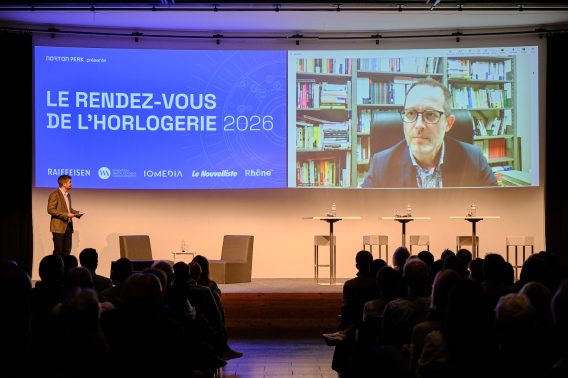
Watchmaking took root in Valais after World War II, when Swiss manufacturers were looking for new labour pools. Since then, the sector has evolved from low-cost subcontracting to creative, high-value-added projects. However, it still relies on external expertise and markets and thus remains vulnerable. It is the picture drawn by historian Pierre-Yves Donzé, professor at the University of Osaka and visiting professor at the University of Fribourg, during a conference on the history of the industry in the canton.
Today, according to official figures from the Federation of the Swiss Watch Industry, the watchmaking industry in Valais employs 524 people. It accounts for 2% of Swiss watchmaking companies and 1% of the industry’s total workforce. One question runs through the presentation: where did these companies come from, in an Alpine canton that was not an obvious location for this type of industry?
The early days: finding labour
It all began after World War II, when small workshops started setting up operations in Valais. The first one, Ebauches SA (ETA), was established in Vollèges in 1948. Another one opened in Isérables in 1957. The reason was simple: the industry needed an ever-growing workforce.
At the time, Swiss Made regulations prevented manufacturers from relocating production abroad. It was also impossible to hire foreign workers, in order to protect manufacturing secrets. “To recruit Swiss workers, one had to go where the workers were, and that was in Valais”, summarises Pierre-Yves Donzé.
In 1963, Michel Carron opened Norrac in Fully, the canton’s first proper factory. The State of Valais played a key role: the local workers needed training, and watchmaking courses were organised at the vocational training centre. “This made it possible to train watchmakers very quickly”, says the historian.
Cheap labour, then assembly
Between 1955 and 1975, the sector reached 800 employees. This workforce was inexpensive but largely unskilled and was involved in the manufacturing of components and Roskopf movements. From 1970 onwards, movement assembly began to expand, with Monnat & Charmillot in 1970, Rhodanus in 1973 and the Swiss Association of Watch Manufacturers in 1974.
The workforce had fallen to 600 in 1985. Norrac went bankrupt in 1980, and the Isérables site was converted to other uses in 1983. This decline was driven by the quartz crisis and the growing strength of the Japanese watchmaking industry, which was producing watches on a large scale.
The 1990s revival
The sector picked up again thanks to high-end subcontracting. Hubert Lorenz founded Mimotec, a start-up specialising in high-quality microtechnology components, with 24-karat gold parts since 2019. Sigatec began working with silicon in 2006, while Swiss Polissage was established in 2011. The local watchmaking industry was undergoing a renewal.
Some companies took things a step further: they modified watch movements and began offering private-label services. Examples include Monnat.ch, established in 2007 and notably involved in the acquisition of West End Watches; Rhodanus Watch, established in Upper Valais in 1990; and YZ Production Horlogère, founded in Sierre in 2011. “Subcontracting expertise is now being put to use in more ambitious and substantial watchmaking projects”, explains Pierre-Yves Donzé.
New business models
From the 2010s onwards, a more creative watchmaking scene began to emerge in Valais:
- Ange Barde Watch has been offering sports watches in limited editions since 2010, with production based in Neuchâtel.
- Since 2023, Hora Horlogerie has been drawing on its experience in Geneva’s watchmaking industry to create one-of-a-kind timepieces to order.
- Since 2025, Norton Peak has been building on a concept and design developed in Valais, powered by a movement made by La Joux-Perret.
For the historian, two key points stand out. First, the importance of expertise from outside of the canton, particularly from the Jura Arc and Geneva. Second, the presence of a strong entrepreneurial spirit in Valais. “Even though the technical expertise comes from outside the canton, this entrepreneurial spirit has made it possible to move from financial and technological dependence towards value creation within Valais.” According to him, the watchmaking industry in Valais is now “unusual but far from insignificant”.
Genuine creativity, but fragile
From a Valais perspective, there is genuine creativity, but the industry remains fragile due to its reliance on external expertise. The decline in watch production volumes could also become a challenge in the long term. The ongoing transformation of the Swiss watchmaking industry is benefiting Japanese brands in the affordable price segment, as well as Swatch with some of its products. “Swiss watchmakers are being pushed upmarket”, observes Pierre-Yves Donzé. The strength of the Swiss franc does not help matters, especially given the sharp decline in the value of the yen.
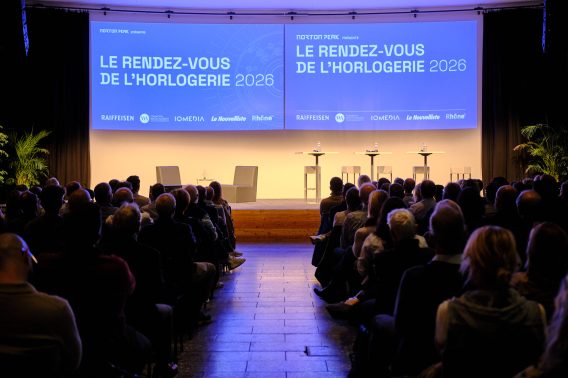
Based on remarks made on 9 October 2026 at the Rendez-vous de l’Horlogerie, Foire du Valais.
Fotos : ©Collaimages