
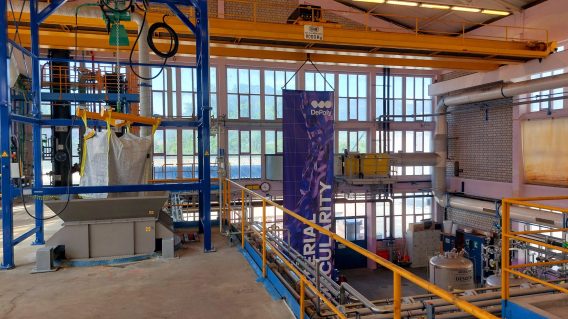
DePoly inaugurated its demonstration plant on July 6th at the Monthey chemical site. A major step for this Valais-based start-up, which is now capable of producing – on an industrial scale – PTA from plastic waste. A technological achievement recognised by the whole ecosystem of Valais, which has supported the company since its early days.
The plant transforms various types of plastic waste, including PET and polyester, into PTA (purified terephthalic acid), one of the key components used to manufacture plastics. This raw material, which comes entirely from recycling, can then be reused by plastic manufacturers, paving the way for a circular economy.
“DePoly was born from the urgency to act against plastic pollution, which is everywhere”, explains Bardiya Valizadeh, co-founder of the company. “It would normally have taken decades to develop this technology. It had to be done, but it had to be done quickly, thanks to engineering and chemistry.” Six years after its creation, DePoly has managed to deploy its technology on an industrial scale. “It went incredibly fast, thanks to the ecosystem of Valais and Switzerland”, underlines the co-founder. Among the key innovations of this success: the DePoly reactor, which will eventually be able to recycle all types of plastic waste, from simple packaging to more complex materials (textiles for instance), using a single unit. “Our plant in Monthey is not the end of it. We are going to deploy this technology on a larger scale.”
Unfailing support from Valais’ ecosystem
According to Paul-André Vogel, director of CimArk, this inauguration is above all the achievement of a remarkable team. “They are brilliant researchers who became entrepreneurs. They were tenacious enough for this plant to be built in Monthey.”
He also recalls the special context in which the start-up operates. “The team knows how to thrive when conditions are favourable, just like in 2024 when it was elected number one Swiss start-up. But the following year, the investment environment changed. Though the plastic problem, for its part, did not disappear. People simply shifted their priorities.”
The passage to the industrial stage was a major challenge. “How do you convince people that it will work? This was what required the most effort. Building a plant means building an entirely new industry.” According to Paul-André Vogel, this success proves that outstanding research can become an industrial reality. “And it is done here, in Monthey, a land with a strong industrial tradition. Without the support of the canton of Valais and of every stakeholder of the ecosystem, this would have not been possible. Investment in deep tech is long-term investment, and it ends up paying.” This investment has notably been supported by the canton of Valais and Economic Promotion Valais’ partners.
Monthey, a home for industry… and innovation
Fabrice Thétaz, president of Monthey, welcomes a historic step for its municipality. “Our city has long been shaped by the chemical industry. We built our prosperity on this industry. These days, we need to produce, but we need to do it in harmony with the environment. DePoly is not just another plant, it is the proof that our industry knows how to reinvent itself.”
He highlights the alignment of all stakeholders that made this success possible. “There is no magic behind all this. It is a perfect alignment between public authorities, CimArk, The Ark Foundation and private investors. By choosing Monthey, DePoly respects our past and prepares our future.”
A bridge between research and commercial application
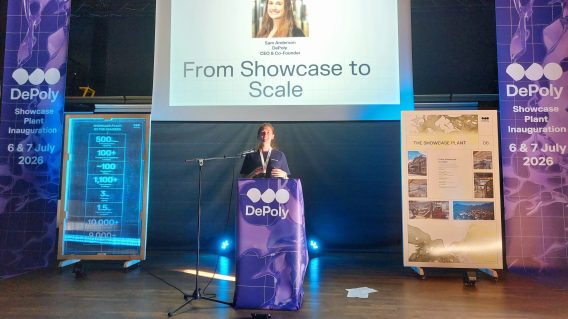
Samantha Anderson, co-founder of DePoly, sees this plant as an essential transition between research and industrial reality. “A new chapter begins today. It is a bridge between scientific innovation and commercial application, a first step that will allow us to recycle more plastic.”
She insists on the notion of resilience, more than mere sustainability. “We want to be a link in the chain for a more circular economy. Our technology works, but it also helps build trust with our customers and consumers. Monthey’s ecosystem is very important to us, it welcomed us with open arms.”
DePoly’s plant in numbers
- 500 metric tons of PTA: annual production capacity of the plant. PTA (purified terephthalic acid) is a key component of polyester, used in combination with mono ethylene glycol (MEG) to produce PET
- More than 100 companies and suppliers involved in the construction of the plant
- Around 100 pieces of equipment installed on the site
- More than 1,100 instruments and valves
- 3 kilometres of pipes
- 5 kilometres of electrical cables
- More than 10,000 hours of engineering were required to build the plant
Plastic, a planetary challenge
- 450 million metric tons of plastic waste are produced each year in the world
- 90 million metric tons of PET and polyester are not recycled each year
- 20% of the world’s oil is used to produce plastic
- Around 500 billion PET bottles are produced worldwide every year, namely 60 million every hour
- 57% of textile fibres produced are made from polyester, a type of plastic
- Less than 10%: the average plastic recycling rate worldwide
It is this global challenge that DePoly aims to address through the technology it has developed in Valais.